What are magnons?
Magnons are collective excitations in magnetically ordered systems.
For the sake of simplicity, the movie illustrates a one-dimensional chain of magnetic moments in a ferromagnetic material. In equilibrium, all magnetic moments in such a ferromagnet point in the same direction.
If one of these magnetic moments is pushed out of equilibrium, like by some external magnetic field, it does not directly go back but rather precesses around the equilibrium direction. This precession of one magnetic moment then influences its neighboring magnetic moment which starts to precess as well but with a slightly different phase, i.e., it drags behind the first magnetic moment. This precessing motion then propagates along the chain of magnetic moments like a wave, which is called a magnon.
What is a magnetic vortex?
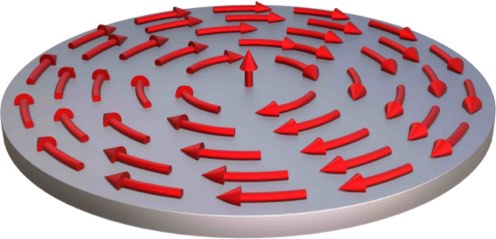
In thin magnetic films, a magnetic vortex describes a non-uniform magnetization state in which the magnetic moments curl around the vortex core, a region where the magnetization points out of the plane. In nano- to micro-meter sized magnetic disks, magnetic vortices occur naturally to avoid surface charges from magnetic moments pointing out of the disk.
The sense of magnetization rotation determines the vortex chirality, the direction of the vortex core defines its polarity.

Which modes exist in a magnetic vortex?
Vortices host two distinct classes of eigenmodes.
First, the vortex core gyration describes a low amplitude translational motion of the core around its equilibrium position at the disk center. Typical frequencies of the fundamental gyrotropic mode lie in the range of a few hundred MHz.
Second, lateral confinement on the order of the spin-wave coherence length gives rise to a discrete spectrum of GHz-frequency magnon modes, characterized by radial (n) and azimuthal (m) indices that count the number of nodes in the radial and azimuthal directions, respectively.
What is magnon scattering?

Magnon scattering processes redistribute energy across the magnon spectrum while obeying energy- and momentum-conservation laws.
Two-magnon scattering refers to the scattering of a magnon at an inhomogeneity (e.g., defects, roughness), which converts it into another magnon with the same frequency but a different wave vector. This process is ubiquitous and does not require large amplitudes.
For three-magnon scattering, two basic mechanisms are distinguished. In a splitting process, one initially excited magnon is annihilated and two secondary magnons are created; in a confluence process, two initial magnons combine into a single secondary magnon. Because of the magnon bandgap and energy conservation, splitting is often forbidden and only happens above a critical threshold amplitude.
In four-magnon scattering, the dominant channel is the conversion of two initial magnons into two secondary magnons. Compared to three-magnon splitting, four-magnon processes typically exhibit a less well-defined threshold and can already play a role at more moderate excitation powers.
What is Floquet engineering?

Under the influence of a periodic driving field, Floquet states emerge due to a temporal periodicity imposed on the system’s ground state, much like the formation of Bloch states in the periodic potential of a crystal lattice. While Bloch states are shifted in momentum space, Floquet states are shifted in energy by multiples of the drive frequency. This way the periodic drive allows for the design of novel properties and functionalities in condensed matter systems.
We are currently working on this website to give you more background on the physical principals of the NIMFEIA project. Thank you for your patience.